
Debt To Income Ratio
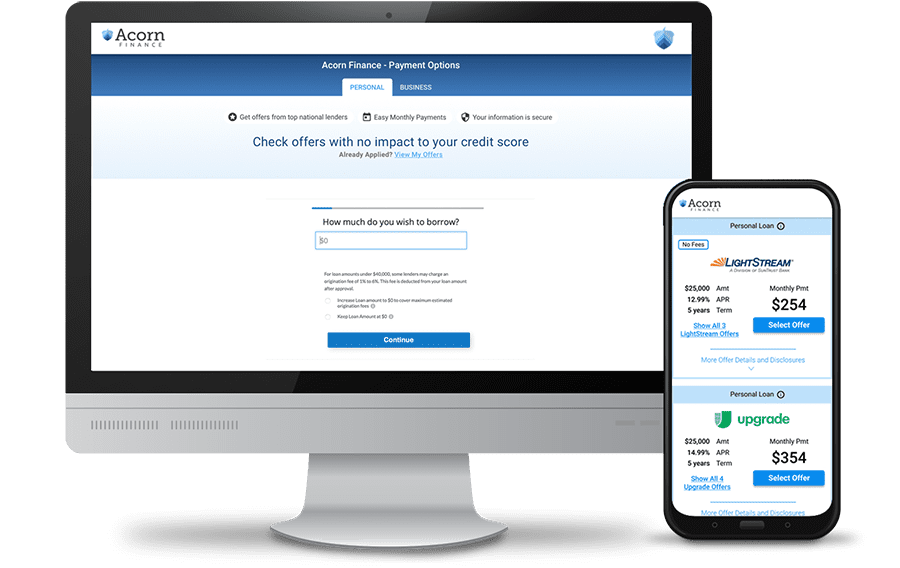

Check offers in seconds
Get pre-qualified for loan offers with an easy online form

Won't impact your credit
Checking offers will not impact your credit score

Competitive payment options
Funding up to $100,000 and APRs as low as 6.99%1

Receive funds quickly

What’s Your Debt-to-Income Ratio?
Your debt-to-income (DTI) ratio is a calculation used by various lenders and financial institutions to determine your basic overall creditworthiness. The DTI ratio is one of the most common metrics used to evaluate a borrower’s financial situation and ability to repay their debts.
It is typically used by mortgage lenders and may also be used in certain other situations in determining whether or not to approve applicants for a loan such as a personal loan.
Quick. Simple. Secure.
How To Apply For Debt To Income Ratio

1 Pre-qualify
Fill out an easy online form to check for pre-qualified offers with no impact to your credit score

2 Select offer
Compare terms and payment options to select the offer that’s best for you

3 Finish application
Complete your application on your selected lender’s website

4 Receive funding
After your loan is approved, your funds should arrive within 1-2 business days2
COMPARE RATES FROM TOP LENDERS











Are you a contractor?
Generate more revenue with Acorn Finance.
Offer customers the ability to finance their dreams with zero dealer fees.
FREQUENTLY ASKED QUESTIONS
Learn More About Debt To Income Ratio
In general, lenders consider borrowers with a higher DTI as a higher risk for loan approval. A debt to income ratio is based on your income versus the debt you’re carrying.
Read more - FAQ
What Does Debt to Income Ratio Mean?
How to Calculate Debt to Income Ratio
The monthly bills you will use in calculating your DTI ratio typically include your housing obligations, any child support or alimony payments, student loan payments, automotive loan payments, credit card payments, and any other monthly debt payments. Generally, monthly expenses such as utilities, gas or groceries are not included in your DTI.
Lenders may use a front-end DTI ratio (which looks only at housing expenses) or a back-end DTI ratio (which includes other debts).
How Does Debt to Income Ratio Work?
Lenders want to see that you will be able to pay back any financing extended to you, and one of the ways this is made possible is by looking at your DTI ratio. While this ratio is extremely important when applying for a mortgage, it is not always used for other types of financing such as personal loans.
Not all lenders use DTI in considering your loan approval, and those who do often have different requirements for what level of debt-to-income ratio is considered acceptable.
What is a Good Debt to Income Ratio?
What Should Your Debt to Income Ratio be?
While every lender has their own thresholds for what DTI ratio they will approve, you are the one who must keep up with the payments at the end of the day. With this in mind, your DTI ratio should be 35% or below to keep your budget manageable. This is the number recommended by financial experts, although most mortgage lenders will approve applicants using a threshold of 43% DTI or even 50% DTI in some cases.
What is my Debt to Income Ratio?
How to Figure Out Debt to Income Ratio?
You can reach your debt-to-income ratio by taking the total of all your monthly debt payments and dividing this number by your pre-tax monthly income.
What is Included in Debt to Income Ratio?
You will not include other types of monthly payments such as utility bills, gas, or groceries.
How to Calculate Debt to Income Ratio for Mortgage?
There are 2 basic types of DTI ratio that your mortgage lender may calculate. The first is known as a front-end DTI ratio and includes all your monthly housing obligations (such as mortgage payment, homeowner’s insurance, property tax, and HOA fees) while the other excludes these expenses and is known as a back-end DTI ratio.
Keep in mind that in the event of a mortgage application, the lender may use your new expected monthly payment to determine your debt-to-income ratio. Your total monthly housing expense will include your mortgage principal and interest, homeowner’s insurance, property taxes, and any applicable mortgage insurance or HOA fees.
Is Rent Included in Debt to Income Ratio?
If your new mortgage is for a rental property, the lender will take your expected rental income into account when determining your debt-to-income ratio. This is how investors and property managers are able to take on multiple properties at once. Each new property that brings in more rental income increases the capacity to take on more debt, keeping the borrower’s DTI ratio within an acceptable range.
How to Lower Debt to Income Ratio?
Increasing your income and reducing the amount of your monthly payments for any debt that you have should result in a sizable decrease in your debt-to-income ratio. For example, if you are in the midst of a loan application for a mortgage, you may want to consider temporarily taking on a second job or finding another way to increase your income.
Similarly, there are several steps you can take to reduce your debt burden. You can pay off the existing debts that you have, use a debt consolidation loan to assist with lowering your monthly debt payment, trade in your vehicle for another, or consider sending your student loans into deferment or forbearance.
Is Debt to Income Ratio Pre Tax?
How Much Debt to Income Ratio to Buy a House?
In addition to getting past the lender’s requirements, you will also want to make sure that you have the capacity to keep up with your mortgage payment.
How Does Rental Property Affect Debt to Income Ratio?
What is a Healthy Debt to Income Ratio?
Do Deferred Student Loans Affect Debt to Income Ratio?
If you have student loans that are deferred or in forbearance, the lender may include them anyway by adding the amount of 1 monthly payment or 1% of the balance into your DTI radio.
Does Being a Cosigner Affect Your Debt to Income Ratio?
Can I Refinance With a High Debt to Income Ratio?
For example, a lender may be willing to overlook a high DTI if your income is high and your credit score is good or excellent. Some lenders are now approving applications with a DTI of all the way up to 50%.
However, if you have a very high debt-to-income ratio and are still having trouble obtaining financing, you may be able to apply using a cosigner or take steps to improve your financial situation and try again in a few months. When your high DTI improves, either by an increase in income or a decrease in your debts, you should then be able to get approved for a refinance.
How to Calculate Debt to Income Ratio for VA Loan?
Applicants for VA loans can calculate their DTI ratio by adding up their total monthly expenses including their mortgage payment and other housing expenses, and dividing that number by their total monthly pre-tax income.
Is Debt to Income Ratio Gross or Net?
Your debt-to-income ratio is calculated based on your gross monthly income. This means that your total income amount before taxes is what is used to make the calculation. Using gross income is the industry standard for many types of financial applications.
Is 37% Debt-to-Income Ratio Good?
Is 43% Debt-to-Income Ratio Good?
How do I Find my Debt-to-Income Ratio?
The quickest way you can find out your own personal DTI ratio is by running the numbers through an online calculator.
ONE HOME, ENDLESS POSSIBILITIES
More home improvement financing options
Your home is a work in progress. Whether you wish to redo, repair or redecorate your home, we can make it all happen with the most effortless financing options.



Trending home improvement projects
Barn Financing Options



Personal loan information
Loans by amount
$1k Personal Loans
$2k Personal Loans
$3k Personal Loans
$4k Personal Loans
$5k Personal Loans
$6k Personal Loans
$8k Personal Loans
$10k Personal Loans
$20k Personal Loans
$25k Personal Loans
$30k Personal Loans
$35k Personal Loans
$40k Personal Loans
$50k Personal Loans
$60k Personal Loans
$75k Personal Loans
$80k Personal Loans
$100k Personal Loans
Learn about personal loans
How To Finance Home Renovations Easily
How To Get a Home Improvement Loan
How Do Home Improvement Loans Work?
How To Finance a Second Home
Contractor Costs To Build a Home
Average Home Improvement Loan Rates
Credit Card Consolidation Loans
Personal Loans for Debt Consolidation
What Are Secured Personal Loans?
Best Financing Options for Home Improvement
$100k Home Improvement Loans
Home Financing Tips for 2021
Personal Loan Refinancing Guide
Secured vs Unsecured Loans
Personal Loan to Pay Off Debt
Trending Articles
Home Improvement Loans In Louisiana
Home Improvement Loans In Oklahoma
Home Improvement Loans In Indiana
Home Improvement Loans In Utah
Home Improvement Loans In Wisconsin
Home Improvement Loans In California
Home Improvement Loans In Michigan
Home Improvement Loans In Florida
Home Improvement Loans In Maine
LMN Acorn Homeowner Financing
CertaPro Acorn Homeowner Financing
JobTread Acorn Homeowner Financing
[object Object]